You are browsing the archive for Community.

ThinkHaus introduction to Python programming sessions

June 13, 2013 in Community, Education

Originally posted on ThinkHaus.org

Python Powered

Date: Weekly — starting Wednesday June 19, 2013 – 7pm
Place: think|haus – see side bar for details
What: Learn how to program in Python!
You need to bring: A notebook computer with Python and a decent text editor installed (see the wiki article for details)

$20/pay-what-you-can per session — 5 sessions total

Register Here

Details: Learn how to program in the Python language! These classes are targeted at those with no knowledge of Python, including those with no knowledge of programming at all. We’ll be covering all the base mechanics of the language, from printing and math through making packages and classes, plus a little on structure and best practices – you can see our full itinerary on the wiki.

Fees will be on a pay-what-you-can basis, with a suggested price of $20 per session ($100 for the full course of five sessions). If that’s too much for you, pay whatever you think is fair. Pay on a per-session basis or all up-front, skip a session if it’s not worth the cost, pay more if you think we’re really helping you, or less if you didn’t get much out of a session. We want to be flexible about it.

If you want to hear more, comment on the schedule, or talk about the content, join the course mailing list.

DemoCampHamilton12 demo line-up announced

June 12, 2013 in Community, DemoCamp

When: Wednesday June 19th from 6:30pm – 9:00pm

Where: The Art Gallery of Hamilton – Joey and Toby Tanebaum Pavilion

What: DemoCamp is an event format that involves a keynote speaker, about 5 software demos which each consist of 5 minutes of actually demoing the software and 5 minutes of Q&A, followed by general socializing with the good company in attendance.


Demos

Demo 1
FluidMedia will demo a Community Story Telling platform for schools, sports and families that prints top quality books with corresponding digital editions on mobile, tablet and web.

Demo 2
Sean Roberts (@sean_j_roberts) is going to show off a nifty command line interface Factor[e] (@factor_e) just developed that helps them develop websites faster than ever.

Demo 3
Bandwave.fm lets fans sell their favourite artist’s content in their own free online music store. Artists exchange unique rewards like meet and greets, tickets, merch or even a direct cut of their record sales to super fans that sell and promote their content for them.

Demo 4
MRX is a Digital Sports Solutions Company from Hamilton Ontario Canada. MRX provides a robust Content Management System for sports properties that allows them to update and share content across their League. Furthermore MRX offers many solutions for sports organizations and teams that they may not have internally, from analytics consulting to Digital Business Strategies.

Demo 5
Crate is a music player with an innovative remote control implementation that allows it to be controlled by any device with a recent browser on it. It’s great for people with iPod speaker docks, or for use at parties where you’d like to open up your music to your guests.

Demo 6
Jennifer Turliuk (@JenniferTurliuk) is a marketer, maker, entrepreneur, career coach, writer, DJ, kiteboarder and salsa dancer. She’ll be talking about how she and a team at ThinkHaus (@ThinkHausOrg) printed a 3D printer with a 3D printer.


Keynote

dale

Dale Mugford


Co-Founder of BraveNewCode


Dale Mugford (@DaleMugford) is President of Design & Product Experience for BraveNewCode’s (@BraveNewCode) products and services. He also provides direction for company communications. For over 15 years, he previously designed websites independently, notably working on cutting-edge web experiences for Canadian recording artists, authors, and businesses before co-founding BraveNewCode with Duane. In his spare time Dale enjoys meeting up with other creatives, doing a little fishing, & spending time with his fiancée and her son.

BraveNewCode is a Hamilton-based startup that amongst others are demonstrating that you can make a global product right here. This month they released their WordPress plug-in WPTouch Pro 3 that powers the mobile version of over 25 million WordPress websites, or 39% of total WordPress websites worldwide. BraveNewCode is also leading the charge on organizing Hamilton’s first WordCamp event (@WordCampHamOnt) along with Orbital.


Check out this (open content) YourHamiltonBiz coverage of the event.


Hamilton: the next Waterloo?

June 7, 2013 in Community, Startup

Editor’s note: Last Fall I was contacted by Dylan C. Robertson, a journalism student creating a project called ONset to cover Ontario startups. In November of 2012 he published this article covering Hamilton.


Mohawk College sits atop Hamilton Mountain. A platform down the street overlooks the city’s aging steel mills and industrial downtown.

In the heart of the main campus, past its wind turbines and glass walls, Jerad Godreault, 21, types sporadically on his Macbook. He sits on an IKEA couch at iDeaWORKS, the college’s innovation hub that takes bright students with ideas and equips with them resources and know-how.

Godreault, a software development student, co-founded the medical app Imaginauts with his brother Leo, a nursing graduate. Their app tracks a patient’s prescription compliance by reminding them to take their drugs, and logging when they do. Doctors can monitor the data, which can suggest when in the day a prescription works best.

A born-and-raised Hamiltonian, Godreault is enthusiastic about his city’s “nurturing, supportive community.” He’s also a test case in a concerted effort to transfrom this municipality of 520,000 from a gritty steel town to a hub of medical tech innovation.

Audio: Jerad Godreault on Hamilton’s start-up community

The iDeaWORKS lab is a concrete-walled room with tables of computers, multiple whiteboards and binders of information on co-op placements. Three-dimensional cardboard figures from video games hang from the ceiling, including Zelda’s Triforce logo and the Super Mario question-mark cube.

Godreault is sending messages to people he met at recent networking events. He’s asking for votes in Startoff Hamilton, a city-wide, month-long contest where start-ups pitch their idea to Hamiltonians, who vote for the best idea.

The contest, with $150,000 at stake, has attracted 27 teams. Stickers with 8-bit graphics promoting the long competition are peppered across the city.

Godreault is good at contests. In May, Mohawk College sent him to Vancouver, where he competed and won the e-Health 2012 Apps Challenge.

“That was really cool,” says Godreault, adjusting his boxy, thick black-framed glasses.

The $3,500 competition required entrepreneurs to pitch their app to health software professionals. Judges grilled all nine teams, and Godreault says he was ready because his instructors prepared him for it.

“We learned how to pitch and get people interested and paying attention. I knew nothing about pitching,” he says. “I’m a guy with an idea. They showed me how to make it work.”


- / -


Kevin Browne is on a mission to change the face of Hamilton.

As a 29-year-old computer science PhD candidate at McMaster University, his decade-long career has included a 16-month stint in Waterloo, Ontario’s tech mecca.

“[Waterloo’s] a nice place to live; good place to raise a family,” Browne says. “But Hamilton is home to me. And we have so much to offer.”

Despite Hamilton’s low cost of rent, vibrant art scene and sizable downtown, it wasn’t enough to keep his tech colleagues from Mohawk and McMaster in town.

“Every year, I lost all my friends. They’d go for jobs in Toronto, Waterloo, New York, Silicon Valley… It was very personally frustrating,” Browne says.

In 2010, after years of the usual rotation, he asked a friend why he chose to leave Hamilton.

“He said you need a community; you need events and networks,” Browne recalls. “You can’t just create this out of thin air.”

Determined to stop the brain drain, Browne gathered his friends together and launched Hamilton’s first DemoCamp in March 2011. Copied from the monthly Toronto event that kicked off in 2005, these one-evening mini-conferences involve a guest speaker and five software demonstrations.

Hamilton’s first event attracted 100 people, including unfamiliar faces.

“I knew people were out there,” Browne says.

Things snowballed. Within a year, Hamilton had multiple monthly and annual events, from networking and competitions to employee-employer matchmaking sessions.

In early October 2012, the city held its second annual Lion’s Lair event, a take on Dragon’s Den that sees 10 entrepreneurs compete for $100,000 in investment and contracts. Both events sold out, with over 500 guests and plenty of media coverage.

Browne’s initiative is only part of the story. Local colleges, universities, city planning departments and employers are taking an all-hands-on-board approach to making new technology a key part of Hamilton’s economy.

“We’re all on the same page and it’s not an issue to say ‘Hey, I’m doing this event, do you have anyone who could help me out?’” says Carolynn Reid of the city’s economic development department, which offers consulting, funding and promotion.

While Hamilton officials keep limited data on how many tech start-ups are based in the city and how many people they employ, figures point to growing innovation sector. At least one tech patent is filed from Hamilton each week, and the city’s digital footprint can bee seen through the hundreds of stickers and 17,000 unique voters logged in October’s Hamilton Startoff competition. CBC launched its first digital-only branch in the city this spring after radio frequencies weren’t available.

A big force behind this shift toward new technologies has been Innovation Factory, a non-profit, provincially funded organization that connects start-ups with investors and resources. It even mirrors the tech industry’s penchant for unconventional spelling: iF.

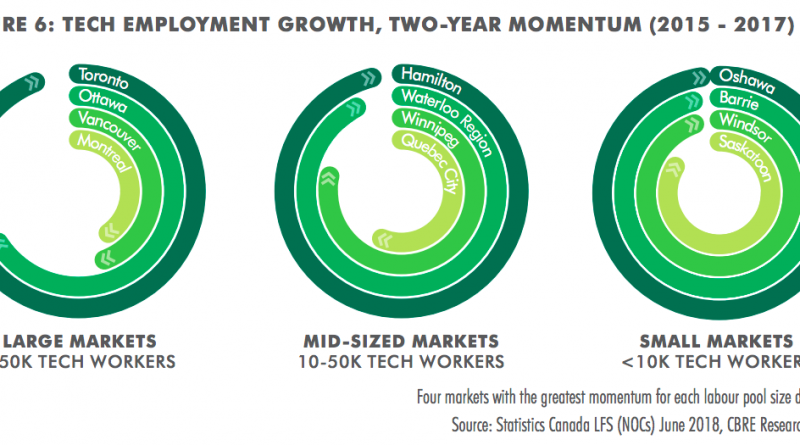
In less than two years, iF counts 350 start-up clients, half of which work in information and communications technology. That gives Hamilton’s tech industry roughly a fourth the heft of Waterloo, a city the province started investing in as a tech hub in the 1960s.

If building a tech base from scratch is a challenge, fighting negative impressions is no cakewalk.

“I never thought of living in Hamilton until I actually explored the city. It differed in every way from my first impression,” says Keanin Loomis, iF’s chief advocate who has lived in Waterloo and Washington, DC.

“The people are friendly and really down-to-earth. I fell for the city.”

Start-ups have followed a similar path, like REfficient, an online marketplace where businesses can buy and sell surplus inventory across seven countries. Founded in Mississauga, the company moved to Hamilton last year to save 30 per cent of their business costs and rent, and hasn’t looked back.

But Loomis says Hamilton can be dwarfed by its proximity to Toronto, and long-held perceptions linger.

“When people from Southern Ontario hear Hamilton, they see the steel mills along the QEW,” says Loomis.

The other route into Hamilton is through Hwy. 403, which passes by the McMaster Innovation Park, a red-brick building in the city’s west end where researchers and entrepreneurs share workspaces and ideas.

“Steel’s important to our economy and our identity, but we’re so much more,” says Reid, from the city’s economic development department. “People have to come and see the city for what it is.”


- / -


It’s a windy Thursday night in October and The Winking Judge, a microbrewery pub operating in a Victorian house, is bustling.

Upstairs, a group of about 30 techies is chatting big ideas. Some are in their 20s, but most are mid-aged. Almost all are male. Unbuttoned cardigans are in vogue tonight, as is pumpkin-flavoured beer.

It’s the one-year anniversary of StartUpDrinks, an informal monthly evening where ideas, business cards and craft draught flow.

“I can’t think of a reason to leave the city,” says Steve Veerman, a software developer for Postmedia who was raised in Hamilton. “You have events like tonight, and a bunch of stuff that Kevin [Browne] got going and some sort of tech culture here.”

Outside his day job, Veerman is working on Eventity, an app that crawls through buzz on social media and to map out what’s popular in the city. Tonight, he’s also hawking for votes for the online Startoff Hamilton competition.

Over the course of an evening, two strangers will come up with an idea for an app and write it on a napkin, a young entrepreneur will land a job interview and almost everyone will discuss the city’s monthly outdoor art crawl that happened earlier that week.

“From what I can see, we’re blossoming as a city,” says Duane Hewitt, a biologist by trade who’s hoping to expand his consulting work into mobile health technology. “Hamilton’s sort of the best place for health-focused work.”

Many of the projects discussed at this month’s StartupDrinks have a medical focus. Hamilton is where most North American eHealth records systems are designed, and the city hosts medical competitions like Apps for Health.

Healthcare has long been the city’s second industry after steel, propelled by decades of health research from McMaster, the province’s largest medical school. Through new technology start-ups, health is remerging as Hamilton’s raison d’être.

The city’s switch to health innovation echoes the path travelled before by Kitchener and Waterloo, two cities that pivoted from insurance companies and manufacturing to mobile innovation over the past two decades.

Communitech, a Waterloo non-profit similar to Hamilton’s iF, estimates that 30,000 people are now employed in more than 1,000 tech firms in the Kitchener-Waterloo area, with new ones popping up at a rate that doubles every year.

Just as Waterloo start-ups brought the city’s focus to mobile innovation, Hamilton start-ups are looking to make waves in medical technology.

“A lot of my clients have health-related businesses. I guess health is sort of our bridge into the tech world,” says Tim Miron, an accountant who works with many start-up clients. He points across the bar to some entrepreneurs he’s been chatting with, all in their 20s.

“We’ll get there through these guys.”

Hamilton HIVE what’s happening update

June 3, 2013 in Community, Hamilton

hamilton_hive_logo_250

Hi everyone, this is your weekly HIVE update about some of the great things happening in Hamilton, check it out:


SPECIAL OFFERS AVAILABLE:


Thursday June 13th – HHCA/YLG Spring Golf Classic:  Special Rate for HIVE Subscribers

The HHCA’s YLG will be returning to Glendale for their Spring Golf Classic!  Registration fee includes a BBQ lunch, 18-hole round of Golf with Carts and a fabulous dinner and much more!  HIVE Subscribers can take advantage of the discounted Early Bird Rates by contacting Stephanie Galez (stephanie@hhca.ca).  More details about the event are available here.


EVENT LISTINGS:


Wednesday June 5th – Get to the PowerPoint

This is a free after-hours seminar being held at Platform 302 to help you improve your PowerPoint presentations.  More details here.


Thursday June 6th – Annual GenNext Spring Networking Breakfast

The GenNext spring breakfast is an annual breakfast event featuring an inspiring keynote speaker, a gourmet breakfast and door prizes!   All proceeds for the event go towards supporting the United Way of Hamilton/Burlington.  More details here, or get your tickets right away on the EventBrite page:  http://www.eventbrite.ca/event/6878779615


Thursday June 13th – Barton Village BIA Real Estate Tour

Come out for the first ever Barton Village Real Estate Crawl, a great chance to see properties within the BIA boundaries and learn about incentives from the City.  More details here.


Thursday June 20th – HHCA Boat Cruise

Enjoy a BBQ dinner and live music on the 2013 HHCA Boat Cruise, setting sail on the Hamilton Harbour Queen.  More event details here.


Thats it for this week!  Thanks for tuning in.


This update has been brought to you courtesy of our founding sponsor, First Ontario Credit Union.


Mike Kubes
Administrator – Hamilton Hive
905.975.5823

http://www.hamiltonhive.ca


Want to get a jump start on networking in Hamilton?  It’s all about who you know; Sign up for your free account on Hive Connect and get connected to Hamilton’s mentors today.


Collaborators – GO Train – Toronto LSW Line

May 26, 2013 in City of Hamilton, Community, Hamilton, IT

hamiltongotrain


I am a commuter on the LSW GO Train line into Toronto. I have been looking to make better use of my time on the train. I am wondering if there are any like minded people that take the train that might be interested in using this time to collaborate on something.

I am a software engineer by trade and I am looking to co-ordinate train meet ups with others. I figure with close to 2 hours on the train a day, it would be an excellent opportunity to collaborate on something.


Matt Dalrymple is a software engineer interested in emergent technologies, RIA and hand held development. He can be found on Twitter: @mwdalrymple.


Interview with Matthew Hollingshead of Hifyre

May 6, 2013 in Community, Technology, Web

matthewMatthew Hollingshead has spent the last 16 years as a Creative Director in the Advertising and Video Game industries. Matthew has lead projects for clients such as Mattel, K-Swiss, Puma, Universal, Playboy, GSK, & Novo Nordisk. These projects have ranged from print packaging, television commercials to mobile games and applications that have reached over 10 million installs. As part of Groove Games, Matthew built the prototype and played a major role in raising $36m in funding to build the first video game based skill gaming site. According to his children, he is now to old to be any good at video games. They are correct.


What’s Hifyre about?

Hifyre (@Hifyre) is about innovating unique and effective ways for businesses to communicate with their customers. We strive for simplicity. Our products create quantifiable data that can be used to help refine marketing strategies.


Who are some of your clients?

  • Mattel
  • Ancestry.com
  • Novo Nordisk
  • Glaxo Smith Kline
  • Baxter
  • Astellas
  • MTV
  • Master Lock
  • Student Price Card
  • Andritz
  • World Vision
  • Playboy
  • Canada Dry Mott’s
  • Omnicare
  • Universal Pictures
  • Universal Music
  • Last Gang Records
  • Spin Master
  • K-Swiss
  • Puma
  • Aliiance Atlantis
  • Eli Lilly


Hamilton Based Companies

  • Hidden Pony Records / Upper Management
  • Clearcable


Handling a wide assortment of clients has got to be a whole lot of work.  Are there any productivity tips and tricks you can share? 

The key to handling the chaos of multiple projects for multiple clients is first having a fantastic project manager. The one person who stays on top of everything about every project. Second is using a great online management system such as Trello.  It is also important at the very beginning of a project to make sure you have a clear list of task and milestones. That way everyone knows what needs to happen next and never have to ask, ‘What do I work on next?’.


What is your thought process when designing a mobile app solution for a customer?

Simplicity, Simplicity, Simplicity. We define what is the core goal of a project, and continue to refine our strategy until we reach the simplest and most effective way for an app to meet that core goal.


What do you think about the HTML5 vs native mobile app debate?

The majority of our applications are built using a Hybrid method. There are benefits to both methods. Native tends to be more robust, while HTML5 is quick and cost effective.  I believe platforms such as Appcelerator are really setting the standard for future development.


In this YourHamiltonBiz article you mentioned that you left Hamilton for Toronto 10 years ago and that you’ve noticed a change upon returning.  Can you elaboration that? What was Hamilton like 10 years ago, what’s changed, and what do you think we need to do to keep changing for the better?

It is a ‘community self worth’. Having grown up in Hamilton, I’ve always been a firm believer that Hamilton has some of the most creative people in Canada. The problem was that people outside and inside of Hamilton only ever saw the ‘Steel Factories’ and a blue collar workforce. It think that’s finally changed, there is a revived sense of pride in being a Hamiltonian. People can feel that. It’s nice to speak with people and clients from outside of Hamilton and have them ask questions about it, not just dismiss it as Steel town.

One thing I’ve noticed since I’ve moved back to Hamilton is that people are always asking ‘How do we get people outside of Hamilton to recognize what we have here?’. People and businesses are noticing what’s going on. Stop worrying about other people’s opinions, keep working hard and providing great services and products, and they won’t be able to ignore us. Attention and recognition are a byproduct of success.


hifyre


Any advice for would be web / tech entrepreneurs?

Work hard, work smart. Find something you are passionate about. Find people who are equally passionate about the same thing and have complimentary skill sets. Then ‘Build small. Think big.’ and get that product out there. Your audience will be the ultimate judge.


What’s next for Hifyre?

We are continuing to grow our core service business and keep attracting top tier clients and brands. We are getting set to officially launch our new product ‘Hiwyre’ which is a cloud-based sales enablement & sales training tool for iPad.  We are also building key partnerships with other service providers to help broaden our reach into new industries.


What is Startup Weekend?

April 17, 2013 in Community, Contest, Startup Weekend Hamilton, Technology

I’m Alex Pineda. I’m a software developer in Hamilton over at Mabel’s Labels. I do a whole lot of coding, QA, learning and appreciating what I have. I’ll be talking about ServiceStack this Thursday at CoderCamp. I blog and tweet. Follow me!


SWNEFor those considering attending this years Startup Weekend, it’s difficult if not impossible to know what to expect. Even the name Startup Weekend is surprisingly opaque. I think first and foremost you should understand, what is a Startup? After that, you can start to digest just why this event is so unique and wonderful for all those who attend. It’s hard to succinctly name or describe it but here I try to offer just a little insight. I would say, quite generally, that Startup Weekend is where you go to make the intangible tangible.

Startup Weekend is a gathering. It’s people that love the success story. People that love hearing about 4 moms figuring a way to beat the lost & found and then happily serving hundreds of thousands of customers for 10 years and on. Or how about Julie Allison of Eyebobs eyewear, fulfilling her own need (as many founders do), controlling growth to suit her lifestyle and building an amazing product to serve others with similar needs of affordable corrective lenses. Or how about a software product example with Bingo Card Creator. A simple straightforward product with good UX gets you a long way, and not to mention very satisfied customers. Startup Weekend brings exciting people around exciting ideas for an entire crash course on learning, hustle, team work, business development, product development, and friendly competition.

Everyone has a different reason for going to Startup Weekend. I think you should go for any of the following reasons:

A) Networking. Meet new people, and learn what they do, and get inspired. We don’t bite.
B) Skill Development. Focus on your key talent and help a team with your skill set. Feel good about your contribution. It can be anything from social media, copywriting, design, negotiation, you name it.
C) Self Discovery. Focus on something you normally would never do, be it coding, marketing, face-to-face customer discovery  etc.
D) Product Development/Enhancement. Focus on your existing product idea and have others help you build it and possibly improve on it. You’ll be surprised what others can throw in into the mix if you let them.

Last year I went to put my coding skills to work. I had the honor of being a winner alongside Mohamed El Mahallawy, Bilal Husain, Shawn McTigue (co-founder of Mac Entrepreneurship) and the rest of the Nervu crew that year. We had great discussions and ideas. We all watched the product (and presentation) change and evolve before our eyes. It was an awesome experience and one I want to experience again.

This year the venue will be at the new and spacious Radius Cafe on James street south. This year my focus will be on product development and code. I will be pitching an idea and hope to win the ability to work on my product with many of you talented folks. Come be a part of something awesome and come to Startup Weekend Hamilton 3 on Friday April 26th til Sunday April 28th.

Business is about life, and Startup Weekend celebrates that with a passion.


Sign-up for Startup Weekend Hamilton 3

A big, big thank you

April 16, 2013 in Community, Innovation Factory

Last week I attended the annual Big DiF event hosted by Innovation Factory (@itsbeginswithIF) with about 300 other people. The event featured an open house with demos and setups by companies like Hard Circle, OverAir and Weever Apps, as well as a lot of networking in the open space at McMaster Innovation Park Atrium. Innovation Factory is Hamilton’s regional innovation center and part of a province-wide network of similar centers, the equivalent organizations would be Communitech in Waterloo or Mars Discovery District in Toronto. They’ve been doing an excellent job promoting innovation locally and helping startups in the Hamilton-area succeed. Check out this video that they played at The Big DiF:


Since last year they’ve been awarding a “Difizen” of the Year award to somebody that has made a big difference in the innovation community. Last year’s winner was Jim Rundick (@JVRudnick), a successful entrepreneur (CanuckSEO and KKT Interactive) and a great Hamiltonian that mentors many local startup founders and contributes to the community tirelessly. The award itself is named after Mark Chamberlain (@mj_chamberlain), a business and community leader famous for his leadership of WesCam amongst many other succeses. At this year’s event, I was thrilled and honoured to win the award!

awardAs people that know me well or read this blog have already heard before, I’ve been a McMaster student for 10 years from a Bachelors degree to now finishing a PhD. Over the years I’ve seen friend after friend come into town and get a great education, and then leave town for lack of a stronger technology sector. Sure, lots of people leave the place where they went to school, even in a mature tech city like Waterloo. But all of them leave? Between seeing McMaster students leave, and family and friends that I grew up with leave, all because of the “jobs problem” in Hamilton, I got really, really frustrated. So I started organizing tech events like DemoCamp, StartupDrinks and Startup Weekend to act as a catalyst for a stronger software industry. It’s been a lot of work over the last couple years, but it’s also been a blast. I love seeing this industry grow in Hamilton. I love organizing events, it’s been the best hobby in the world. That’s why it felt really awesome to win this award. I’ll always be grateful.

A big, big thanks to everyone that has either sponsored, presented at, or attended a Software Hamilton event, along with everyone that has contributed content of any kind to this blog. These initiatives really wouldn’t have been what they were if not for all the help and support from the community. Innovation Factory themselves have been fantastic supporters and partners on these different initiatives, having sponsored every single DemoCampHamilton event. Hamilton Economic Development, Mohawk College and McMaster University have also regularly sponsored DemoCamps, with each of FluidMedia, Factor[e], Gowlings, Orbital, KPMG, The Art Gallery of Hamilton, SR&ED One, and the Hamilton Chamber of Commerce also sponsoring a DemoCamp. Dozens of speakers volunteered their time to come out to these events and dispense their knowledge or put their product out their for criticism/feedback, and the community has benefited from this sharing of experience. Again, a big, big thanks to everyone!

Many community building theories stress the importance of volunteer work. I’ve heard that volunteering 10% of your time is optimal. Startup Communities author Brad Feld suggests spending 20% of your time, “These leadership roles are not full-time jobs – they are volunteer positions! Think of Google 20% rule… 20% of your time should be dedicated to whatever you want… so spend 20% of your time leading the startup community.” I couldn’t afford to pay people to talk at events. Most people can’t afford to pay for a mentor. But volunteers can step up and fill the gap and make it happen for the community.

I’m a believer in the power of volunteer work, mostly because of my grandmother.

In 1979, my grandfather had a brain aneurysm. He survived, but he would never be remotely the same or ever get better. He would require constant care for the rest of his life. Experiencing this kind of tragedy can break a person. But my grandmother had a particularly unconquerable soul. She took care of him at the long term care facility where he stayed for 29 years, until he passed away in 2008.


june


She went far beyond taking care of my grandfather though. She put thousands upon thousands of volunteer hours in at the facilities where he stayed. Pushing wheelchairs, feeding patients, and running activities for patients. She added joy to the lives of so many people in their final years. She continued after my grandfather passed on. At 84-years-old she was still riding the bus every day from her house in the east end all the way to the west mountain, to take care of other people, just because that’s what made her happy. And she did it all with a smile and sense of humor too. Her passion was an inspiration to everyone that knew her.

She passed away a month before the first DemoCamp. I’ll always be thankful to her for teaching me the value of volunteer work.

Thanks to everyone who has volunteered their time in our community. And I encourage anyone to volunteer their time for others, whether it’s in this community or another. Step up. Fill a gap. Make it happen. I promise it will make you happy.


Stages of community building

April 5, 2013 in Community

peckPhotoScott Peck was an American psychologist, famous for his ten million copy selling book The Road Less Traveled. Scott developed a four stage classification of community building that’s proven popular over the years. Scott himself never claimed that all communities go through these stages or that communities happen by formula, only that this was the usual order of things.


Pseudocommunity
For many groups or organizations the most common initial stage, pseudocommunity, is the only one. It is a stage of pretense. The group pretends it already is a community, that the participants have only superficial individual differences and no cause for conflict. The primary means it uses to maintain this pretense is through a set of unspoken common norms we call manners: you should try your best not to say anything that might antagonize or upset anyone else; if someone else says something that offends you or evokes a painful feeling or memory, you should pretend it hasn’t bothered you in the least; and if disagreement or other unpleasantness emerges, you should immediately change the subject. These are rules that any good hostess knows. They may create a smoothly functioning dinner party but nothing more significant. The communication in a pseudocommunity is filled with generalizations. It is polite, inauthentic, boring, sterile, and unproductive.

Chaos
Over time profound individual differences may gradually emerge so that the group enters the stage of chaos and not infrequently self-destructs. The theme of pseudocommunity is the covering up of individual differences; the predominant theme of the stage of chaos is the attempt to obliterate such differences. This is done as the group members try to convert, heal, or fix each other or else argue for simplistic organizational norms. It is an irritable and irritating, thoughtless, rapid-fire, and often noisy win/lose type of process that gets nowhere.

Emptiness
If the group can hang in together through this unpleasantness without self-destructing or retreating into pseudocommunity, then it begins to enter “emptiness.” This is a stage of hard, hard work, a time when the members work to empty themselves of everything that stands between them and community. And that is a lot. Many of the things that must be relinquished or sacrificed with integrity are virtual human universals: prejudices, snap judgments, fixed expectations, the desire to convert, heal, or fix, the urge to win, the fear of looking like a fool, the need to control. Other things may be exquisitely personal: hidden griefs, hatreds, or terrors that must be confessed, made public, before the individual can be fully “present” to the group. It is a time of risk and courage, and while it often feels relieving, it also often feels like dying.

The transition from chaos to emptiness is seldom dramatic and often agonizingly prolonged. One or two group members may risk baring their souls, only to have another, who cannot bear the pain, suddenly switch the subject to something inane. The group as a whole has still not become empty enough to truly listen. It bounces back into temporary chaos. Eventually, however, it becomes sufficiently empty for a kind of miracle to occur.

Community
At this point a member will speak of something particularly poignant and authentic. Instead of retreating from it, the group now sits in silence, absorbing it. Then a second member will quietly say something equally authentic. She may not even respond to the first member, but one does not get the feeling he has been ignored; rather, it feels as if the second member has gone up and laid herself on the altar alongside the first. The silence returns, and out of it, a third member will speak with eloquent appropriateness. Community has been born.

The shift into community is often quite sudden and dramatic. The change is palpable. A spirit of peace pervades the room. There is “more silence, yet more of worth gets said. It is like music. The people work together with an exquisite sense of timing, as if they were a finely tuned orchestra under the direction of an invisible celestial conductor. Many actually sense the presence of God in the room. If the group is a public workshop of previous strangers who soon must part, then there is little for it to do beyond enjoying the gift. If it is an organization, however, now that it is a community it is ready to go to work-making decisions, planning, negotiating, and so on-often with phenomenal efficiency and effectiveness.”

Excerpt from the book A World Waiting to be Born by Scott Peck (Bantam Books, New York, 1993)


Scott was also a spiritual guy as you can tell. The stages may seem a bit too intense or philosophical when applied to a lot of communities. But I remember reading about these stages years ago, and the more time that passes the more I think there’s something to them. When a community first begins to form, it isn’t really much of a community at all. Everyone is new to everyone else and naturally trying to make a good impression. People generally don’t criticize and try to be nice. The problem with everyone “being nice” is that it can lack authenticity.

criticsI remember going out to a Hamilton tech startup event a couple years ago where entrepreneurs were presenting their products. Nobody in attendance criticized anything, despite some pretty glaring problems. Maybe people just didn’t feel comfortable criticizing, sometimes it’s not so much a matter of being too nice as it is not feeling qualified or knowledgeable enough to deliver criticism.

That’s part of why peer-to-peer relationships, especially founder-to-founder relationships, are valued the way they are. It can be aggravating to receive criticism that’s from a position of unjustified authority or knowledge. Nobody is a level 10 black belt guru expert engineer social master spirit guide. People want to talk to their peers first and foremost, because those are the people that really understand the challenges involved. It’s why the best mentor relationships become peer to peer relationships overtime too.

At a more recent Hamilton tech startup event somebody very openly questioned a fundamental aspect of a startup’s business model. They went beyond asking the “generic business model question” and critiqued a specific aspect of the business model as being fundamentally unworkable. I think some people thought he was heckling. But the criticism was more constructive than abrasive. It was authentic communication, delivered as one peer to another, openly and honestly. Who knows whether his criticism was correct or not. But either way, the entrepreneur can take in the criticism and adjust however they see fit, including not at all, and everyone else in the room was able to absorb the information too. True community involves a lot more than critical questions at tech events, but the example illustrates what I think is a trend.

I’ve noticed a real shift away from pseudocommunity in Hamilton over the last year. People are just getting to know one another better, gaining more confidence, and learning to effectively and honestly communicate with one another. Of course that involves chaos and negativity. But that’s really just growing pains. You can’t really place Hamilton or any other city into one of these four stages. There is no end point, and it it will never be perfect. And that’s OK.

Hamilton tech podcasts: Dyscultured

March 4, 2013 in Community

dysculturedAwhile back I posted a couple articles covering tech podcasts with Hamilton connections – Sounds Legit and The New Biz. It turns out I missed one called Dyscultured (@Dyscultured).

Dyscultured is Canada’s irreverent news, tech and pop culture show.

We skewer the latest news, tech and pop culture happenings north and south of “The 49th Parallel” in a weekly live show/chat/podcast. Each and every week we live by this mantra: Take no sponsors, take no bullshit, take no prisoners.

Anthony Marco (@anthonymarco) is the Hamilton-based podcaster that links the series to the city. Anthony is a highschool teacher with 14 years of experience, and has appeared on CBC’s Q with Jian Ghomeshi, TVO’s “Your Voice”, and the TVO podcast “Search Engine”. He also contributes to the podcasts lovehatethings.com, Best Episode Ever, and TV, eh?.

Check out the latest episode of Dyscultured, “Episode 225 – The Walrus Was Here”: